
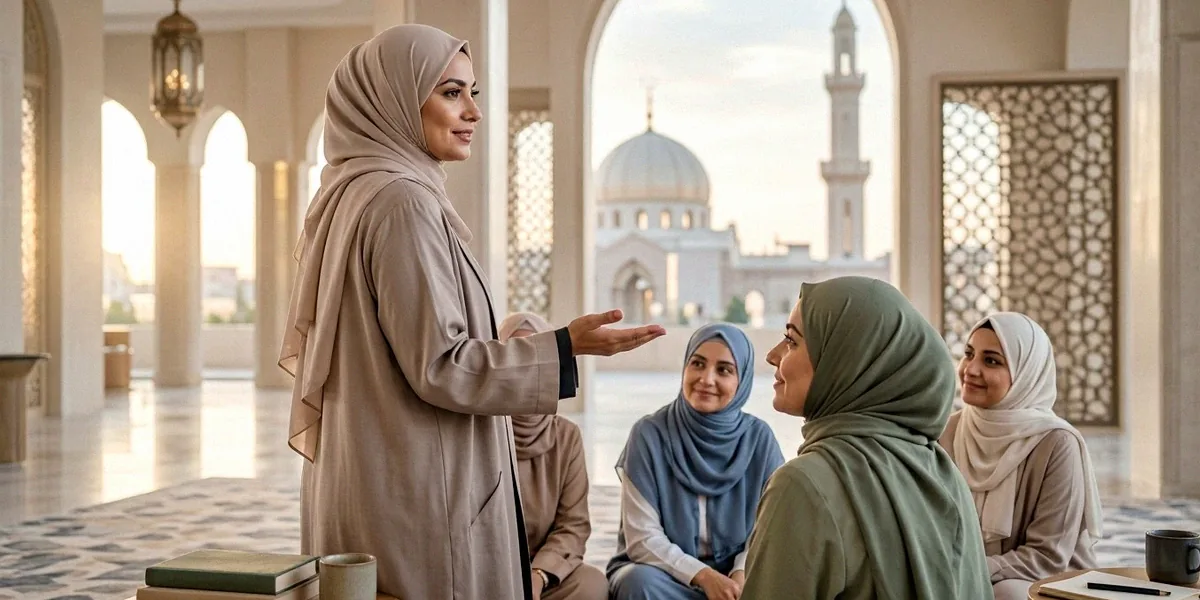
Women-Led Mosque: Muslim Women’s Leadership and Community
When most people in the UK picture a mosque, they picture men. Men leading prayers, men sitting on committees, men making the decisions that shape community life. It is such a common assumption that many Muslims and non-Muslims alike have never stopped to question it. But what if we told you that across Britain, and right here in Bradford, Muslim women are already leading prayers, chairing committees, managing finances, and reimagining what a mosque can be? A women-led mosque is not a fantasy or a fringe idea. It is a growing movement, rooted in faith, driven by community need, and built by women who refuse to accept that leadership belongs to one gender. In this article, we want to introduce you to that movement, explain what it actually means, and invite you to be part of it.
What Is a Women-Led Mosque? Defining the Movement
The phrase “women-led mosque” can mean different things to different people, so let us be clear about what we mean. A women-led mosque is a Muslim place of worship and community where women hold substantive leadership roles. That can include leading congregational prayers, delivering khutbahs (sermons), serving as trustees and committee chairs, managing budgets, and setting the strategic direction of the institution. It is not simply a mosque with a women’s section, and it is not the same as a women-only prayer room tucked away at the back of a building. A women-led mosque places women at the centre of decision-making and spiritual life, not at the margins.
This is a relatively new development in the UK, but it is not without precedent. Throughout Islamic history, women have been scholars, teachers, transmitters of hadith, and in some cases leaders of prayer in their own households and communities. What we are seeing now is a contemporary reclamation of that heritage, adapted to the realities of British Muslim life. Organisations such as the Bradford Muslim Women’s Council and the Inclusive Mosque Initiative have been at the forefront of this work, creating spaces where women’s leadership is not an afterthought but a founding principle.
It is important to distinguish between a women-led mosque and a women-only mosque. A women-only mosque excludes men entirely, often for reasons of comfort or safety. A women-led mosque may still welcome men, but the leadership, governance, and vision are shaped primarily by women. Both models have their place, and both challenge the assumption that mosque leadership is naturally male. The key point is that women are not asking for permission to participate. They are already participating, and they are building institutions that reflect their full humanity and faith.
Women as Imams and Prayer Leaders: Theological Debates
Perhaps no aspect of the women-led mosque movement attracts more attention than the question of women leading prayers. Within Islamic scholarship, there is a range of opinions on this. Some classical jurists permitted women to lead other women in prayer, and a small number allowed women to lead mixed congregations in specific circumstances. Others held that prayer leadership should be reserved for men. These differences are not new, and they are not unique to the UK. What is new is the growing number of Muslim women and men who believe that women’s spiritual leadership should be recognised and institutionalised.
The theological debate is important, and we do not want to dismiss it. But we also want to be honest about what is happening on the ground. In the UK, women are leading prayers in private gatherings, at university Islamic societies, at conferences, and in dedicated women-led spaces. The Women’s Mosque of America, founded in 2015, has become a powerful international example of what a women-led congregational space can look like. It has inspired Muslim women in Britain to ask why similar spaces do not exist here, and to start building them.
We believe that theological debate should continue, but it should not be used as a reason to exclude women from leadership. The Prophet Muhammad’s wife Khadija was a successful businesswoman and a spiritual pillar of the early community. His wife Aisha was a scholar and teacher whose narrations shaped Islamic law. Women have always been part of the story. A women-led mosque simply makes that participation visible and structural.
Governance Models: Beyond Token Representation
Governance is where the real power in any mosque lies. Committees decide budgets, hire imams, manage buildings, and set the tone for community life. Too often, women are invited onto committees as a gesture, given a title without authority, or asked to organise bake sales while men make the decisions. A women-led mosque rejects this model entirely. It ensures that women hold real power, including the power to hire and fire, to allocate funds, and to shape the mosque’s mission.
There are different governance models that can support this. Some women-led mosques operate as charities with a majority-female board of trustees. Others are constituted as community interest companies or informal collectives. What matters is not the legal structure but the distribution of power. If women are not in the room when decisions are made, they are not leading. If they are in the room but their voices are ignored, they are not leading either. Genuine governance means shared authority, transparent processes, and accountability to the community.
In the UK, the Charity Commission’s governance guidelines provide a useful framework. They emphasise the importance of diverse boards, clear roles, and financial transparency. Women-led mosques can use these guidelines to hold themselves and others to a high standard. They can also use them to challenge mosques that pay lip service to inclusion while keeping women out of leadership. The law is on the side of good governance, and good governance includes women.
Women-Led Mosques vs. Women’s Sections: Key Differences
Many mosques in the UK have a women’s section. This is a space set aside for women to pray, often behind a partition or in a separate room. Women’s sections are important, and for many women they provide a comfortable and safe environment for worship. But a women’s section is not the same as a women-led mosque. A women’s section is usually controlled by men. The imam is male, the committee is male, and the budget is decided by men. Women may use the space, but they do not own it or shape it.
A women-led mosque is different in several key ways:
- Leadership: Women hold the top decision-making roles, including chair, treasurer, and trustee positions.
- Spiritual authority: Women may lead prayers, deliver sermons, and provide religious guidance.
- Space: The entire mosque is designed with women’s needs in mind, not just a corner or a back room.
- Governance: Policies, budgets, and strategy are shaped by women, not merely implemented by them.
- Community services: Programmes are developed around the actual needs of women and families, including domestic abuse support, mental health, and youth work.
These differences matter because they change the culture of the mosque. When women lead, the whole community benefits. Decisions are more inclusive, services are more responsive, and the mosque becomes a place where everyone can flourish.
The UK Context: Muslim Women’s Leadership in Bradford and Beyond
Bradford is one of the most vibrant Muslim cities in the UK. It is home to a large and diverse Muslim community, with roots in South Asia, the Middle East, Africa, and beyond. It is also a city with a strong tradition of grassroots activism, particularly among Muslim women. From campaigning for better housing to organising interfaith events, Bradford’s Muslim women have been shaping the city for decades. It is no surprise that Bradford is now at the forefront of the women-led mosque movement.
The city’s cultural life reflects this energy. The Bradford Literature Festival has hosted panels on Muslim women’s writing, leadership, and activism, giving a platform to voices that are often marginalised. Local grassroots organisations, many of them led by women, are working on issues ranging from domestic violence to education to climate justice. These organisations are not waiting for permission from male-dominated institutions. They are building their own structures and creating their own spaces.
Nationally, the picture is also changing. The Muslim Council of Britain has launched women’s leadership programmes designed to equip Muslim women with the skills and confidence to take on senior roles in mosques and community organisations. The Muslim Women’s Network UK has been advocating for women’s rights within Muslim communities for years, providing training, research, and support. These national initiatives are important, but they need to be matched by local action. That is where Bradford comes in.
Bradford’s Muslim Women: A History of Activism
To understand why Bradford is such an important place for this movement, you have to understand its history. Muslim women in Bradford have been organising for generations. In the 1980s and 1990s, they campaigned against racism, fought for better schools, and set up community centres. Many of these women were first-generation migrants who arrived in the UK with little and built lives for their families through sheer determination. Their daughters and granddaughters are now taking that legacy forward.
The Bradford Muslim Women’s Council is a key part of this story. It has provided a voice for Muslim women in the city, advocating for their needs and creating spaces for them to lead. It has also worked to challenge stereotypes, both within the Muslim community and in the wider media. Its work has not always been easy. Muslim women who speak out often face criticism from within their own communities and from outside. But they have persisted, and their persistence is paying off.
Today, Bradford’s Muslim women are involved in everything from local politics to business to the arts. They are imams, teachers, social workers, and entrepreneurs. They are also increasingly taking on leadership roles in mosques, challenging the idea that religious authority belongs only to men. This is not a rejection of their faith. It is an expression of it.
Case Study: The Bradford Women’s Mosque Initiative
One of the most exciting developments in Bradford is the Bradford Women’s Mosque Initiative. This is a grassroots project that aims to create a dedicated women-led mosque space in the city. It is still in its early stages, but it has already generated significant interest and support. The initiative is led by a group of Muslim women who are passionate about creating a space where women can worship, learn, and lead without barriers.
The initiative is not just about prayer. It is about building a community hub that offers a range of services, including educational programmes, counselling, and social events. It is about creating a space where women can bring their children, ask questions, and explore their faith without fear of judgment. It is about demonstrating that women-led mosques are not a threat to tradition but a faithful reimagining of it.
The initiative has faced challenges. Finding a suitable building, securing funding, and navigating the legal requirements of setting up a charity are all difficult tasks. But the team behind it is determined. They have been inspired by the Women’s Mosque of America, which started small and grew into a national movement. They believe that Bradford can be a model for the rest of the UK.
Challenges and Resistance in UK Muslim Communities
We would be dishonest if we pretended that the women-led mosque movement faces no opposition. It does. Some Muslims believe that women leading prayers is religiously impermissible. Others worry that women-led mosques will divide the community or undermine existing institutions. Some resistance comes from a place of genuine theological concern. Some comes from a place of patriarchy and fear of losing power.
We respect the right of people to hold different views. But we also believe that women’s leadership is not a zero-sum game. A women-led mosque does not have to compete with existing mosques. It can complement them, offering something that many women have been missing for years. It can also challenge existing mosques to do better, to be more inclusive, and to take women’s contributions seriously.
Resistance is not only internal. Muslim women who take on leadership roles often face Islamophobia from the wider society, as well as sexism from within their own communities. They are told that they are too visible, too vocal, too ambitious. They are accused of being Westernised or of betraying their culture. These accusations are painful, but they are also a sign that change is happening. If women’s leadership were not a threat to the status quo, no one would bother opposing it.
Community Leadership: How Women Are Reshaping Mosque Governance
Leadership is not just about titles. It is about the daily work of building and sustaining a community. Across the UK, Muslim women are taking on that work in mosques, community centres, and charities. They are serving on committees, managing finances, organising events, and providing pastoral care. They are doing the hard, unglamorous work that keeps institutions alive. And increasingly, they are doing it in leadership positions.
This shift is happening for several reasons. First, Muslim women are more educated and more confident than ever before. They are entering professions like law, medicine, and finance, and they are bringing those skills back to their communities. Second, the wider conversation about gender equality has made it harder for mosques to justify excluding women from leadership. Third, and most importantly, women themselves are demanding change. They are no longer willing to accept a seat at the back of the room.
The Muslim Women’s Network UK has been instrumental in supporting this shift. It provides training programmes for women who want to take on leadership roles, covering everything from charity law to public speaking. It also offers a helpline for women who face discrimination or abuse within their communities. Its work has helped countless women find their voice and use it.
Breaking Barriers: From Volunteer to Trustee
Many women begin their journey into mosque leadership as volunteers. They help with fundraising, organise events, teach children, or run social media accounts. This work is essential, but it is often invisible and undervalued. The challenge is to turn volunteer work into a pathway to leadership. That means recognising women’s skills, offering them training, and creating opportunities for them to step into decision-making roles.
Becoming a trustee is a key step. Trustees are legally responsible for a charity’s governance, and they have the power to hire, fire, and set strategy. In many mosques, trustee boards are dominated by men, often from a narrow demographic. Women who want to become trustees need support to understand the role, navigate the legal requirements, and build the confidence to put themselves forward. The Charity Commission’s governance guidelines can help here, providing a clear framework for what trustees should do and how they should behave.
Some women have made the transition successfully. In Birmingham, a group of Muslim women set up a charity that runs a women-led community centre. They started as volunteers, then became trustees, and now they employ staff and manage a substantial budget. In London, a woman who began by teaching Quran to children is now the chair of her mosque’s committee. These stories are not unique. They are happening across the country, and they show what is possible when women are given the chance to lead.
Financial Transparency and Accountability
One of the most important aspects of mosque governance is financial transparency. Mosques handle significant amounts of money, from donations and zakat to grants and fundraising. How that money is managed and spent is a matter of trust. Women-led mosques tend to prioritise transparency, publishing accounts, holding open meetings, and inviting community members to scrutinise their decisions. This is not just good practice. It is a reflection of the values that women bring to leadership.
Financial transparency also helps to prevent abuse. Sadly, there have been cases in the UK where mosque funds have been mismanaged or misappropriated. Women-led governance can help to reduce that risk by ensuring that multiple people are involved in financial decisions and that there are clear checks and balances. It also sends a message to the community that the mosque belongs to everyone, not just a small group of insiders.
We believe that financial transparency should be a standard for all mosques, not just women-led ones. But we also recognise that women-led mosques are often leading the way in this area. They are showing that it is possible to be both faithful to tradition and accountable to the community.
Building Alliances with Male Allies
The women-led mosque movement is not about excluding men. It is about including women. Many men support this work, and their support is essential. Male allies can use their positions to advocate for women’s leadership, to challenge sexist attitudes, and to share power. They can also help to build bridges between women-led initiatives and existing mosques, reducing suspicion and fostering collaboration.
We have seen powerful examples of this in Bradford and beyond. Male imams who invite women to speak at events. Male trustees who step aside to make room for women. Male community members who attend women-led events and show their support. These actions may seem small, but they add up. They send a signal that women’s leadership is not a threat but a gift.
Building alliances takes time and trust. It requires women to be willing to work with men who may not fully understand their experiences, and men to be willing to listen and learn. But the alternative, a community divided by gender, is not acceptable. We are all part of the same ummah, and we all have a role to play.
Our Vision: A Women-Led Mosque for the 21st Century
Our team has a vision. We want to see a women-led mosque in Bradford that is open to everyone, that serves the whole community, and that models a new way of being Muslim in Britain. This mosque would not be a replica of existing institutions. It would be something new, shaped by the needs and aspirations of the people it serves. It would be a place where women lead, but it would also be a place where men are welcome, where children are safe, and where everyone can find support.
We are inspired by the Women’s Mosque of America, which has shown that women-led spaces can be vibrant, faithful, and sustainable. But we also know that the UK is different. We need models that work in the British context, that engage with British law and culture, and that speak to the experiences of British Muslims. That is what we are trying to build.
Our vision is not just about prayer. It is about creating a community hub that offers a range of services, from education to counselling to social action. It is about building a space where women can bring their whole selves, where they can ask difficult questions, and where they can grow in faith and confidence. It is about showing that women-led mosques are not a compromise. They are an expression of the best of Islamic tradition.
Inclusive Worship: Accommodating Diverse Needs
One of the things that excites us most about a women-led mosque is the opportunity to design worship around the actual needs of the community. Too often, mosques are designed with a one-size-fits-all approach that ignores the diversity of the people who use them. A women-led mosque can do better.
That means thinking about accessibility for people with disabilities. It means providing childcare during prayers and events. It means creating spaces for nursing mothers and for children. It means offering prayers at times that work for people with jobs and families. It means being welcoming to people of all backgrounds, including converts, LGBTQ+ Muslims, and those who feel marginalised by mainstream mosques.
Inclusive worship is not about watering down tradition. It is about living out the values of compassion and justice that are at the heart of Islam. The Prophet Muhammad said that the best of you are those who are best to their families. We believe that a mosque should be a place where everyone is treated with dignity and care.
Social Action: Domestic Violence and Mental Health
Muslim women in the UK face specific challenges that are often ignored by mainstream services. Domestic violence, forced marriage, mental health stigma, and poverty are all issues that affect Muslim women disproportionately. A women-led mosque can be a lifeline for women who are struggling, providing support, advocacy, and a safe space to talk.
We want to develop programmes that address these issues directly. That could include counselling services, support groups, and training for community members on how to recognise and respond to abuse. It could include partnerships with local charities and statutory services. It could include campaigns to raise awareness and change attitudes.
Mental health is another area where Muslim women often struggle to find culturally appropriate support. A women-led mosque can offer a space where women can talk about their mental health without fear of judgment, and where they can access resources and referrals. This is not just a nice-to-have. It is a matter of life and death for some women.
Youth and Interfaith Engagement
Young Muslims in the UK are growing up in a complex world. They are navigating between different cultures, different expectations, and different identities. A women-led mosque can be a place where they feel seen and heard, where their questions are taken seriously, and where they can develop the skills and confidence to lead in their own right.
We want to create youth programmes that engage young people in meaningful ways. That could include leadership training, mentoring, creative projects, and opportunities to serve the community. It could also include interfaith work, building relationships with young people from other faiths and backgrounds. In a city like Bradford, where diversity is a strength, interfaith engagement is essential.
We believe that young people are not just the future of the community. They are the present. Their energy, creativity, and idealism are gifts that we should nurture and celebrate. A women-led mosque can be a place where they flourish.
How You Can Get Involved and Support the Movement
If you have read this far, you may be wondering how you can get involved. The good news is that there are many ways to support the women-led mosque movement, whether you are in Bradford or elsewhere in the UK. You do not need to be a scholar or an activist. You just need to care about creating a more inclusive and just community.
Here are some practical steps you can take:
- Attend local events and workshops. Many women-led initiatives run regular events, from prayer gatherings to educational workshops. Showing up is a powerful way to support the movement and to connect with others who share your values.
- Donate or fundraise. Women-led initiatives often operate on shoestring budgets. Your donation, however small, can make a big difference. You can also organise a fundraiser in your workplace, school, or community.
- Volunteer your skills. If you have skills in finance, law, marketing, or event planning, you can offer them to a women-led mosque or community organisation. Your expertise is valuable.
- Amplify voices on social media. Share articles, posts, and stories about women-led mosques. Follow and support women-led initiatives online. Use your platform to challenge stereotypes and celebrate women’s leadership.
- Have conversations. Talk to your friends, family, and colleagues about women-led mosques. Challenge assumptions when you hear them. Be a voice for change in your own circle.
Attend Local Events and Workshops
One of the best ways to get involved is to attend events at the Bradford Muslim Women’s Centre and other local venues. These events are not just about learning. They are about building relationships and creating a sense of community. You will meet women who are leading change in Bradford and beyond, and you will find ways to contribute your own gifts.
Workshops on topics like mosque governance, charity law, and public speaking are particularly valuable if you are interested in taking on a leadership role. They give you the skills and confidence you need to step forward. They also connect you with mentors and peers who can support you along the way.
Donate or Fundraise for Women-Led Initiatives
Money is not everything, but it is necessary. Women-led initiatives need funding to pay for venues, staff, resources, and programmes. Donating to the Muslim Women’s Fund or to a local women-led mosque project is a direct way to support the movement. If you cannot donate, you can fundraise. Sponsored walks, bake sales, and online campaigns are all effective ways to raise money and awareness.
We also encourage you to think about where your zakat and sadaqah go. Are you supporting women-led initiatives? Are you funding projects that empower women and girls? If not, consider making a change. Your generosity can help to build a more inclusive and just community.
Amplify Voices on Social Media
Social media can be a powerful tool for change. When you share stories about women-led mosques, you help to normalise the idea and challenge stereotypes. When you follow and support women-led initiatives, you give them visibility and credibility. When you speak out against sexism and Islamophobia, you make the online world a safer place for Muslim women.
We encourage you to use your platform, however small, to amplify the voices of Muslim women leaders. Share their posts, comment on their work, and celebrate their achievements. Every like, share, and comment helps to build momentum.
If you are in Bradford, we would love to see you at one of our events. If you are elsewhere in the UK, we hope you will find a way to support the movement in your own community. Together, we can build a future where women-led mosques are not an exception but a normal part of British Muslim life.
Frequently Asked Questions
What exactly is a women-led mosque?
A women-led mosque is a Muslim place of worship and community where women hold substantive leadership roles, including leading prayers, delivering sermons, serving as trustees, and shaping governance. It is different from a women’s section, which is a space for women within a male-led mosque. A women-led mosque places women at the centre of decision-making and spiritual life.
Is it religiously permissible for women to lead prayers?
There is a range of opinions within Islamic scholarship on this question. Some classical jurists permitted women to lead other women in prayer, and some allowed women to lead mixed congregations in specific circumstances. Others held that prayer leadership should be reserved for men. The women-led mosque movement respects these differences but believes that women’s spiritual leadership should be recognised and institutionalised. Many Muslims, including scholars, support women leading prayers in women-only or women-led spaces.
How can I support the women-led mosque movement if I don’t live in Bradford?
There are many ways to support the movement from anywhere in the UK. You can donate to the Muslim Women’s Fund or other women-led initiatives. You can volunteer your skills remotely. You can amplify voices on social media. You can also look for women-led initiatives in your own area and offer your support. Every action, however small, helps to build momentum.
What challenges do women-led mosques face in the UK?
Women-led mosques face a range of challenges, including theological opposition, resistance from male-dominated institutions, funding difficulties, and Islamophobia from wider society. Some women also face criticism from within their own communities. Despite these challenges, the movement is growing, and women-led initiatives are finding creative ways to overcome obstacles and build sustainable institutions.
How can men be good allies to the women-led mosque movement?
Men can be good allies by listening to women, using their positions to advocate for women’s leadership, sharing power, and challenging sexist attitudes when they encounter them. They can attend women-led events, support women-led initiatives financially, and build bridges between women-led spaces and existing mosques. Allyship is not about taking over. It is about standing alongside and making room.
Women-led mosques are not a rejection of tradition. They are a faithful reimagining of community leadership, rooted in the belief that women’s voices, skills, and spiritual gifts are essential to the life of the ummah. From Bradford to Birmingham, from London to Glasgow, Muslim women are building institutions that reflect their full humanity and faith. We invite you to join us in this work. Whether you pray with us, volunteer with us, donate to us, or simply spread the word, you are part of the movement. Together, we can create a future where every Muslim woman has the opportunity to lead, to serve, and to flourish. Visit us at womenledmosque.co.uk to learn more and get involved.
Latest articles
- Women Scholars in Islamic History
 Women Scholars in Islamic History: Reclaiming a Legacy of Knowledge The first person to memorise the entire Qur’an was a woman. The…
- Volunteering During Ramadan
 Volunteering During Ramadan: How Our Women-Led Mosque Builds Community Every Ramadan, the kitchen at our women-led mosque in Bradford comes alive long…
- The Idea of a Women-Led Mosque Explained
 The Idea of a Women-Led Mosque Explained When we tell people we run a blog about women-led mosques in the UK, the…
- Running a Women’s Study Circle
 Running a Women’s Study Circle: A Guide for UK Mosques When we first floated the idea of a women’s study circle at…
- Muslim Women’s Councils in the UK
 Muslim Women’s Councils in the UK: Shaping Women-Led Mosque Governance Picture a packed community hall in Bradford on a Tuesday evening. The…
- Mosque Governance: How Committees Work
 Mosque Governance: How Committees Work Walk into almost any mosque committee room in Bradford and you will notice the same thing: it…